
Read the Knott County Owner Record
Start with the PVA assessment roll. It is the county's working list of who owns what, and its search accepts a parcel number, an owner name, or a street address. Not every field on the parcel card is guaranteed to appear the same way each visit, so note which labels you actually see rather than assuming a full set. The owner name alone means little. Read it together with the parcel ID, the roll date, the situs address, and the deed reference, because the same name can attach to several tracts in Knott County.
| Owner name | Exact roll spelling and whether it names a person, trust, estate, or entity |
|---|---|
| Mailing address | Destination for assessment or tax mail, not proof of residence |
| Situs | The physical property location or locally used address |
| Parcel or map ID | The cross-office key for the tax, map, and deed trail |
| Last sale | Date, price, or deed citation only if the live card actually displays it |
| Roll year | The assessment date needed to judge whether a sale may be newer |
An owner of record is simply the party named in the public record. It is not proof of who lives on the land. The mailing address and the situs address often differ for good reasons. A post office box may receive the notices. A trustee, an attorney, or an out-of-county owner may receive them too. Save both addresses. Then weigh the legal description and the latest deed before treating a mailing match as the final word.
Check the Current Knott County Owner Against Roll Dates
Kentucky sets January 1 as its assessment date. The listing period runs January 1 through March 1. The roll then opens for a 13-day public inspection starting the first Monday in May. Those dates explain most current-owner mismatches. A deed recorded after January 1 leaves the roll and tax bill showing the January 1 owner. A newer transfer exists at the recorder, but the roll has not caught up yet.
A bill may list the new party "in care of." A contract may split the tax between buyer and sellers. Neither changes the assessment date. Write down the deed date, the recording date, the roll year, and any card refresh date. When the timing stays unclear, the Knott County PVA at 606-785-5569 can say which cycle the displayed name represents. That beats guessing from a sale date alone.
Recent-sale check. The roll can lag a transfer. For the most current public transfer clue, compare it with the newest recorded deed.
Verify Knott County Ownership Now
Verification is a short present-tense comparison, not a full chain of title. Begin with the PVA name. Then pull only the newest recorded transfer that matches your parcel or legal description. The Knott County Clerk holds the deeds. The clerk points searchers to eCCLIX, which requires an account and subscription. If that gate blocks you, the clerk's office at 54 West Main Street in Hindman can route an index or image request.
- Search the Knott County PVA by address and preserve the exact owner spelling and map ID.
- Use the map ID, name, and legal description to seek the newest deed through eCCLIX or the clerk.
- Compare the grantee, recording date, legal description, and prior-record citation with the parcel.
- For an LLC, check the Kentucky entity filing, while recognizing that it does not establish beneficial ownership.
- Owner of record
- The party shown by the assessment roll or recorded transfer.
- Assessment roll
- The PVA’s dated list of taxable property and assessed information.
- Recording lag
- The gap between a deed filing and a later public-system update.
- Situs
- The parcel’s physical location, distinct from the owner’s mail address.
The Knott County Card Gap
The PVA homepage earns trust for one reason. Its local quick-search label is verified and current. The qPublic result page behind it, however, sits behind a Cloudflare challenge. So the exact owner fields, value layout, last-sale label, sketch, exemption flags, and card refresh stamp on a Knott County card are not documented here. A careful owner check reports that limit. It does not borrow labels from another county's qPublic system.
The official Knott County PVA page is the starting point for any parcel query. It also handles owner and address searches.
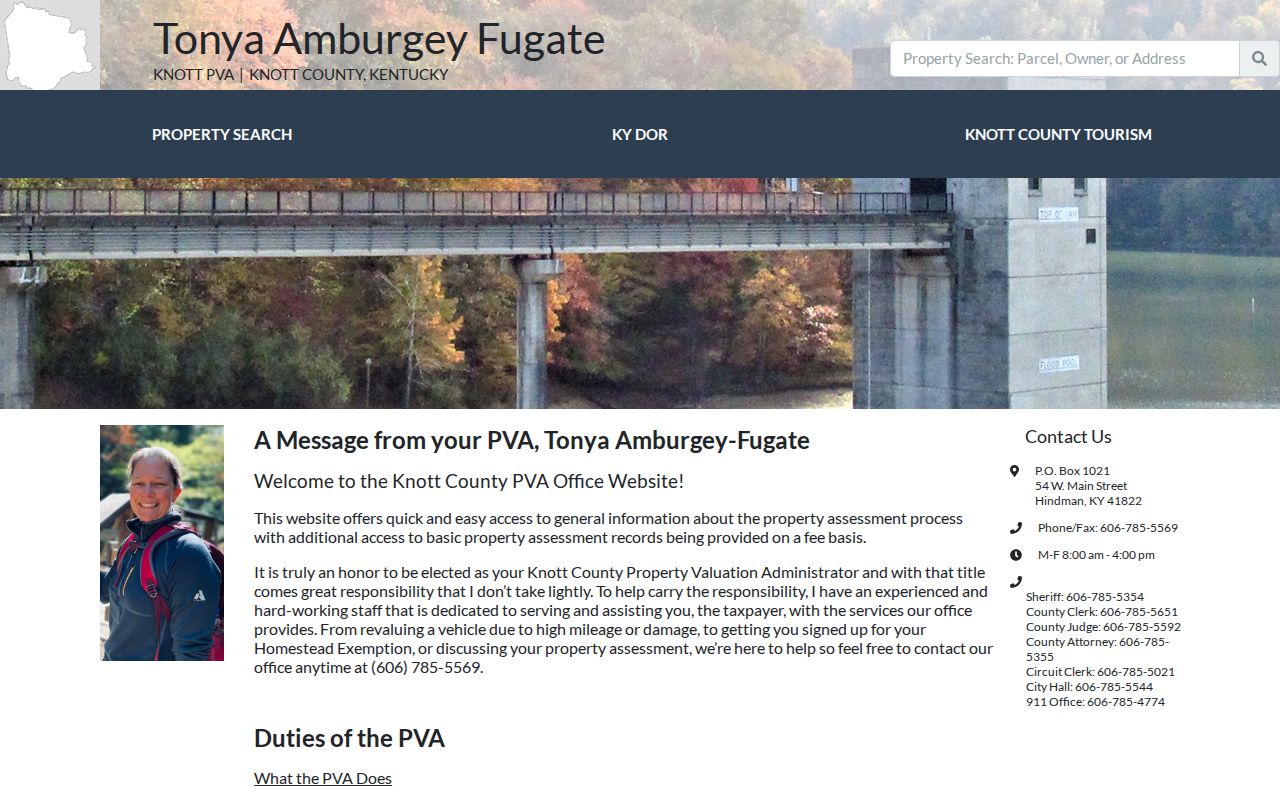
The homepage confirms the three entry keys: parcel, owner, and address. It does not reveal which owner or sale fields appear after a selection is made.
If online access stays blocked, use the counter or the phone. The PVA sits at 54 West Main Street, P.O. Box 1021, Hindman, Kentucky 41822, open weekdays from 8:00 a.m. to 4:00 p.m. Basic assessment records are available on a fee basis. The office publishes no full fee schedule.
Verify Current Knott County Entity Owners
A current owner field often names a trust, an estate, or a limited liability company. It may not name a person. Trust entries may use the trustee's name. Estate entries may carry an executor or administrator. An LLC should be searched under its exact legal suffix and spelling in the Kentucky Secretary of State business search. That file can supply filed documents, a registered office, and a registered agent. The state notes it does not determine beneficial ownership.
Keep two questions separate. The deed says which named entity received the real-estate interest. The Secretary of State file helps identify that entity and its public contact. Neither one alone proves who decides everything for the company or trust. For an estate or court-ordered sale, a probate, foreclosure, partition, or commissioner case may be indexed in CourtNet. The case file itself stays with the local court clerk.
Separate Knott County Tax Status
The county clerk's delinquent-tax system gives you a second, narrower check. Verified fields cover bill number, tax year, owner, and purchaser. They also include map ID, property address, status, and amount range. Matching controls help too. A hit can confirm the name and parcel spelling on a delinquent record. Treat it as a cross-check. It is not a fresh deed.
A purchaser on a delinquent-tax record may simply be a third party who bought the tax bill. That person or entity is not automatically the current deed owner. Before drawing any conclusion, look at payment, redemption, and certificate status. Check related court action and any later deed or release. This distinction keeps a Knott County current-owner lookup anchored to the present transfer record. It avoids tax-sale assumptions.
Note: The sheriff collects during the annual window, and delinquent bills later move to the county clerk's process.
Protect Current Knott County Owner Addresses
Kentucky Safe at Home supplies a substitute address and mail forwarding for qualifying survivors. The program's rules say plainly that real-estate holdings stay publicly available. That does not make sensitive personal details fair game for republication. A roll address can also be stale, indirect, or a care-of destination. Use the official mailing route only for a legitimate property matter.
The Kentucky Open Records Act allows written requests for nonexempt records. It generally requires an agency response within five business days. Privacy and other exceptions apply. Ask for the property record you actually need, not restricted personal data. A narrow request keyed to a parcel, deed, or roll entry works better. That approach avoids mixing in unrelated people.
Contact a Knott County Owner Lawfully
The owner mailing address in an assessment or tax record is the public contact clue. The situs is simply the land's location. Keep the two straight. Write about the parcel and state your reason for contact. Do not assume the owner lives at either address. Never lean on neighbors, relatives, or unrelated records to pressure someone. For a purchase, boundary question, estate matter, or deed correction, keep a copy of the parcel ID. Keep the record citation with your letter too.
A current owner record is not a title opinion. It is not a survey either. Easements, mineral rights, life estates, liens, and unrecorded claims can all complicate ownership. One display name may hide more than it reveals. Knott County's historical mineral-lease books are a sharp reminder. Surface and mineral interests may travel down separate record lines.
Lawful use. Contact a Knott County owner only for a legitimate property purpose. Never use owner or address information to harass, threaten, stalk, or harm anyone.