
Deed Types in Knott County
The instrument type shows how a transfer arose and who held authority to sign it. Kentucky archive guidance names general deeds plus commissioner's, sheriff's, executor's, and master commissioner's deeds. A label alone defines nothing. Read the granting clause and the exceptions. Then check the land description. Only then can you decide what interest actually moved.
| Deed Type | What It Does | Common Use |
|---|---|---|
| General or warranty | Conveys the stated estate with written promises | Ordinary transfer |
| Quitclaim | Conveys only the interest a grantor may hold | Family or title cleanup |
| Commissioner's | Conveys under a court-directed sale | Foreclosure or partition |
| Executor's | Conveys through estate authority | Probate administration |
| Sheriff's | Records a transfer under legal process | Statutory sale |
Not everything filed beside a deed is a deed. Mortgages, liens, mineral leases, assignments, and releases play other roles. They may burden, reserve, lease, or release an interest. In Knott County, surface and mineral chains can diverge. So coal and mineral terms deserve a separate deed search of their own.
The instrument type also points to the next record. An executor's deed leads to a probate file. A commissioner's deed leads to a court order and a sale confirmation. A sheriff's deed may grow out of tax process or other legal action. Record the exact caption rather than flattening every instrument into a generic sale. The signing date, recording date, consideration, reservations, and prior deed citation each carry weight. They answer a different question about how the stated interest moved.
Knott County Clerk Deed Access
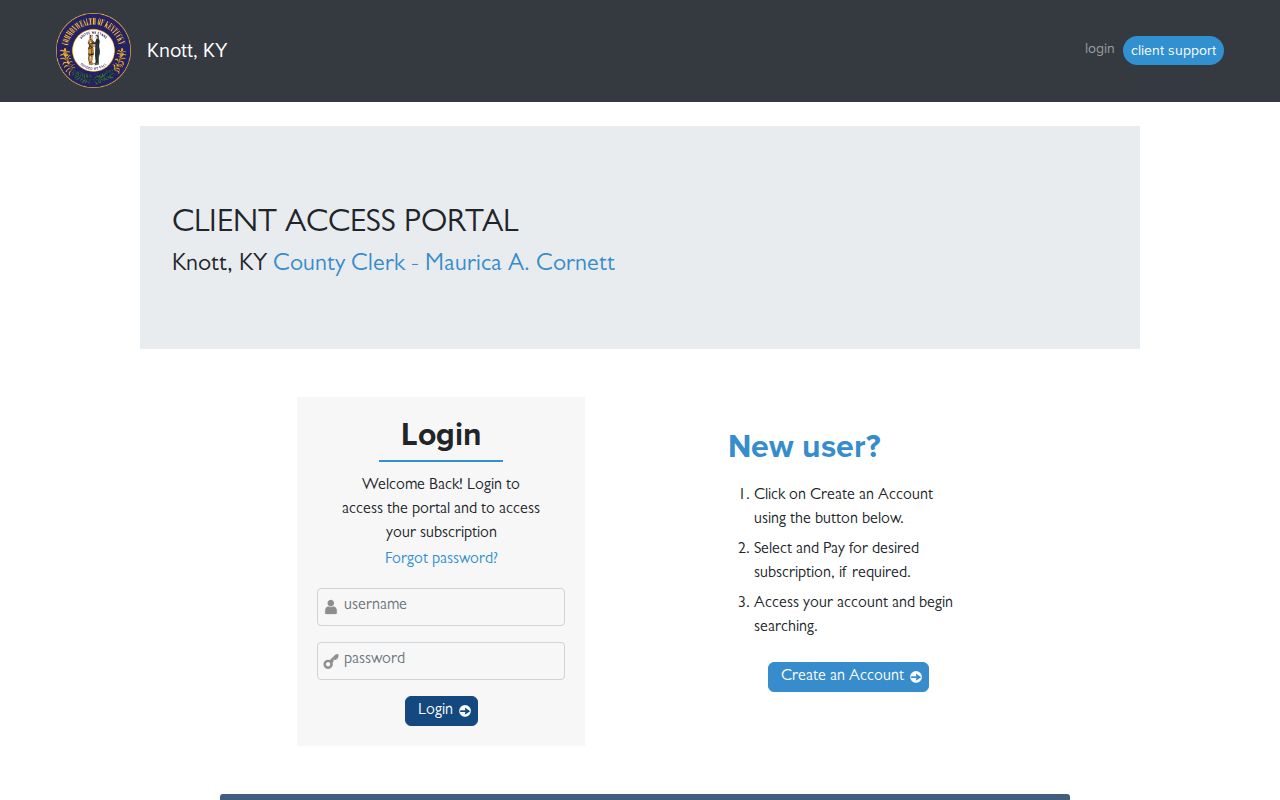
The Knott County Clerk is where recording begins. The office sits at 54 W Main Street, Hindman, Kentucky 41822, and publishes 606-785-5651 and 606-785-0870 as its phone numbers. Ask whether a record can be viewed at the counter, on an office terminal, by mailed request, or from archive film. The official online route runs through eCCLIX. That system requires an account, a CAPTCHA, and a subscription plan. The index start date, search fields, image price, and certified-copy schedule sit behind that login.
When online access fails, fall back on the counter, the phone, mail, or a written Kentucky Open Records Act request for an existing record. Give the clerk enough identifiers to find it. Names, a date range, deed type, book and page, and instrument number cut down false matches. A full tract description does too. Ask whether the office keeps a public terminal. It may expose an index or image an anonymous web user cannot reach. For archival film, contact KDLA at 502-564-1770 and cite the county, series, and year.
Read Knott County Deed Indexes
A deed index has two sides. The grantor conveys the stated interest. The grantee receives it. Start with the newest deed tied to the parcel, then work backward through whoever appears as grantor. Kentucky archive guidance suggests spelling variants and special H, C, or S headings for heirs, companies, and sheriffs where they apply.
- Find the present owner's acquisition deed with that owner as grantee.
- Copy the grantor, prior reference, date, and full legal description.
- Search that grantor as an earlier grantee, using name variants.
- Repeat while acreage, roads, streams, and monuments identify the same land.
- Move to office books or KDLA film when the web trail ends.
- Grantor
- The party conveying the stated interest.
- Grantee
- The party receiving the stated interest.
- Chain of title
- The linked sequence of transfers for the same land.
- Book and page
- A volume and page locator for a recorded instrument.
Confirm the land at every step. A same-name hit proves little on its own. It needs a parcel description, an adjacent owner, acreage, a road, a stream, or a prior reference tying the entry to the tract. Entities and estates need the same discipline. Search the legal LLC or trust name exactly as the instrument prints it. Then test spelling and suffix variants. An estate may sit under the decedent, the executor, the administrator, the heirs, or a court-appointed seller. The Kentucky Secretary of State business search can clarify an entity's filed name. It cannot decide beneficial ownership or replace the county deed.
Knott County Deed Books
The KDLA land inventory lists Knott deed microfilm from 1884 through 2015. It also covers surveys from 1884 through 1930. Tax books run from 1889 through 1892. Those are archive coverage dates, not a verified start for the eCCLIX index. Office books and state film remain key channels when online images stop.
KDLA also flags a courthouse disaster in 1929 without naming the harmed books. If a chain breaks, ask about the volume. It may have survived. It may have been rebuilt, moved, or never indexed. A failed online search is not proof that no deed exists. Search both index sides, then ask the clerk and KDLA about the missing series.
Note: Preservation, imaging, indexing, and public web access are separate stages. Ask which stage applies to the volume you need.
Land Clues in Knott County Deeds
Compare lot and block, acreage, survey dates, creeks, highways, monuments, adjoining owners, access, and easements. A 2024 Knott sale notice described a quarter-acre through an elm tree. It also cited marked rocks, Highway 1087, a driveway, a water system, and shared access. Wording like that can outlast a street number. It can also separate two tracts held by people with similar names. Copy a metes-and-bounds description in full. For subdivision land, carry the plat book and page into the clerk's plat series. A short summary may drop the one clause that distinguishes the tract or grants access. When a description changes, compare acreage and references for a split, a combination, or a correction.
Minerals in Knott County Deeds
Knott County's records room holds deep mineral history. A 2023 clerk proposal catalogs 21 mortgage books spanning 1884 to 1969. It also lists 27 mineral-lease books covering 1894 to 1974, and five plat books running from 1950 to 2023. Pull these series whenever a deed references coal or minerals. The same goes for a reservation, an assignment, an old mortgage, or a release.
Preservation is a work in progress, however. The proposal called for KDLA security microfilm, TIFF files, and index images. But a plan is not a finished product. Ask the clerk which stage was completed and where each series can be searched today. Keep in mind that mineral title can travel a separate chain from surface ownership.
Court-Ordered Knott County Deeds
Court-ordered conveyances start with legal process, not a handshake. Search CourtNet by Knott County and party name. Then request the actual case file from the circuit clerk for the sale order, parties, appraisal material, and confirmation. The online index never replaces the custodian's file.
A tax purchaser listed in the delinquent portal is not yet proof of a deed transfer. Confirm redemption, court action, and the later conveyance before drawing conclusions. Knott County offers no property-fraud alert signup. So verify any deed-copy mailer by contacting the clerk through independent, official channels.
Request Knott County Deed Copies
Start with an online image when the eCCLIX account exposes one. A missing page, older volume, or certified copy means contacting the clerk. Include party names, the recording date, deed type, and the book and page or instrument number. Add a parcel description. Ask about current search, page, certification, mail, and archive retrieval charges. Knott County publishes no copy-price table, so confirm fees directly.
The Knott County Public Library keeps an in-library genealogy collection with staff help. That help may surface useful name clues. It does not replace a recorded copy. For older deeds, KDLA may hold the relevant film. The archive can explain its research-room access and copying rules.
Recorded, not guaranteed. Knott County deed records show instruments accepted for recording. They are not a title opinion and cannot rule out every unrecorded interest.
Use a certified copy when the receiving office requires it. For a purchase, estate, boundary, mineral, or lien dispute, get advice from a qualified Kentucky professional. Never rest the whole question on one deed.