
Trace Former Knott County Owners
Ownership history is a sequence of transfers. No single assessor line tells the story. Start with the newest matching deed. In Knott County, the grantee received the stated interest, and the grantor becomes the first prior-owner lead. Move backward only when the acreage, branch or creek, road, adjoining owners, and prior-record citation all support the same land.
| Transfer Date | Grantor to Grantee | Deed Type | Book/Page |
|---|---|---|---|
| Newest verified recording | Copy both parties exactly | Record the instrument label | Start with its cited volume and page |
| Grantor's acquisition | Prior grantee becomes the next lead | Note warranty, quitclaim, executor, or commissioner deed | Follow the prior-record reference |
| Next earlier transfer | Repeat only after matching the land | Preserve reservations and conveyed interests | Log each confirmed volume and page |
| Archival continuation | Use both name indexes | Keep the deed type shown in the book | Request microfilm when the web trail ends |
Recent deeds sit with the County Clerk, and eCCLIX serves them online when account access works. Depth comes from archives. The Kentucky Department for Libraries and Archives inventory anchors the deeper run, though not every deed image is online.
Knott County’s Online Deed Gate
The online entry point is the official eCCLIX portal. The portal requires an account, a subscription choice, and a CAPTCHA before any Knott search appears. That gate stops casual browsing. Call the clerk at 606-785-5651 or 606-785-0870, or visit 54 West Main Street in Hindman, for current fields, years, and certified-copy prices when the gate blocks access. An index guides the search. The deed image supplies the description and reservations that connect one former owner to the next in Knott County.
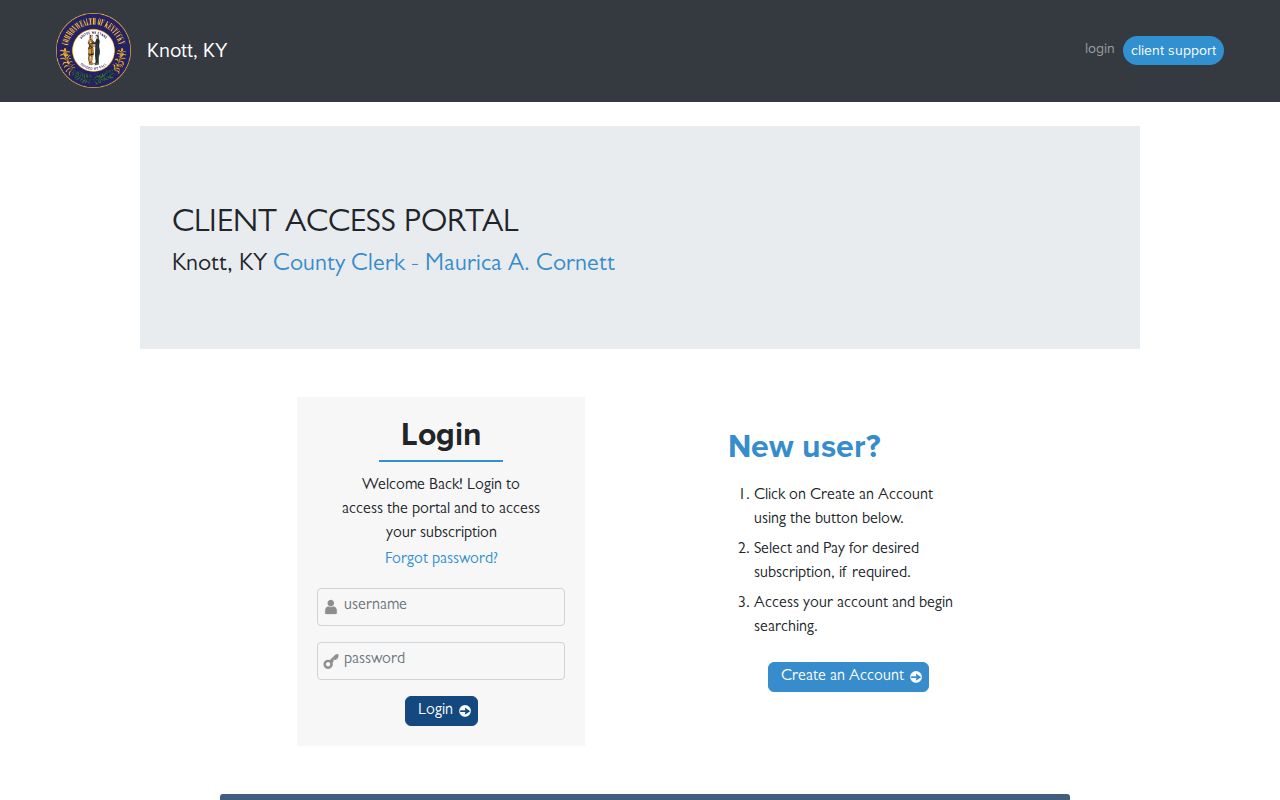
The capture does not establish local coverage or the fee for a certified copy.
Walk Knott County Deeds Backward
KDLA recommends separate grantor and grantee searches in Knott County deed records. Begin with the present deed. Copy the full description and prior reference, then search that grantor as a grantee in an earlier period, watching spelling variants plus H, C, or S headings for heirs, commissioners, and sheriffs. Names shifted often.
- Record the newest deed’s parties, dates, type, and book or instrument citation.
- Copy its legal description and prior-record reference.
- Search the grantor as an earlier grantee and match the same land.
- Repeat through the index, then move to books or microfilm.
- Grantor
- The party conveying the stated interest.
- Grantee
- The party receiving it.
- Chain of title
- The linked transfers for one tract.
- Reverse index
- An index used to follow grantees backward.
- Quitclaim
- A transfer without title warranties.
Deeds do more than transfer names. One can reserve minerals, retain a life estate, or convey only part of a tract, so keep the exact language rather than shrinking Knott County history to a list of owners.
Bridge Early Knott County Owner Gaps
The KDLA inventory lists deed microfilm from 1884 through 2015, tax books from 1889 through 1892, surveys from 1884 through 1930, and wills from 1892 through 2015. Before about 1890, tax records can bridge a lost deed clue. A tax name is not a transfer. Gaps have other causes too. Probate, partition, foreclosure, and commissioner cases can explain a break in Knott County, with CourtNet identifying the case and the circuit clerk keeping the file. Log the authority behind every sheriff, executor, or commissioner deed.
Mineral Records Split Knott County Chains
The clerk's 2023 project catalogued 21 mortgage books from 1884 through 1969 and 27 mineral-lease books from 1894 through 1974. It proposed indexes, digital images, and security microfilm. Ask which stage is accessible today. Surface owners, mineral-interest owners, and leaseholders can differ. Follow reservations, assignments, leases, and releases as a separate chain whenever coal or mineral terms appear in Knott County records. A mineral clause may reserve coal while the surface passes on. A lease can move without the tax card changing. Copy the exact granting and reservation language, the instrument date, the parties, and the book and page. Skip nothing. Then search for a release under every named party. Check the clerk and KDLA when eCCLIX does not expose the image. Keep this branch beside the surface timeline so no prior owner gets credit for an interest the recorded deed withheld.
The 1929 Knott County Record Flag
KDLA flags a 1929 courthouse disaster without naming the affected books. Treat the flag as a gap detector. It does not prove a whole span was lost. Ask about the exact volume, then check tax books, surveys, wills, court files, and special index headings for Knott County. A missing online hit can mean gated access, incomplete imaging, or a changed description. State the uncertainty and name the next source.
Match Knott County Land, Not Names
Old Knott County descriptions lean on branches, creeks, roads, marked rocks, trees, adjoining owners, drives, and water access. A 2024 commissioner notice described a quarter-acre tract through an elm tree, Highway 1087, marked rocks, a driveway, and shared water-system access. Street numbers often fail there. Those clues keep the land's identity. Parcel IDs can change after splits. Compare acreage and boundary calls closely. Search historic community names such as Kite, Fisty, Mousie, or Topmost, and never join people by surname alone. Note: A plat or assessor polygon helps locate land but does not replace the recorded legal description in Knott County.
Limits of Knott County Owner History
The archival anchor for Knott County starts in 1884, the county's formation year, and runs through 2015 on KDLA deed microfilm. Exact eCCLIX depth is unknown. For a single instrument rather than a backward chain, the Knott County deed records resource is the better stop. A personal chain shows previous owners and gaps. It is not a certified title search. Index errors, omitted heirs, mineral reservations, unreleased liens, and survey conflicts may all remain hidden in Knott County property records.
Use the chain with care. Research former Knott County owners for land history and due diligence, never to track, harass, threaten, or harm a living person.